I'm a pushover for the blue elderberry shrub, Sambucus cerulea, and S. racemose. From August to late September, we are out foraging for the ripe, blue, berries of this amazing shrub. We make a tangy syrup from its ripe berries for health benefits and a sweet syrup to pour over pancakes and ice cream. And for the knowledgeable forager, a bounty of survival tools awaits to be harvested including spindles, bows, blowguns, traps, and musical instruments. All of these are from the branches of this amazing and versatile native shrub.

The Blue Elderberry
Blue Elderberries grow in riparian habitats, road banks, meadows, and damp forest openings up to timberline. Berries ripen from mid-August to mid-September in most regions of the US. However, the berries ripen depending on local weather, elevation, and other regional factors.
Our native elderberry family
Sambucus cerulea and S. racemosa, are subspecies of the wild native shrub, ranging from British Columbia south to California. Sambuscus mexicana ranges from Northern California south into Mexico and east into Nevada and Southwestern New Mexico. The S. callicarpa species (Pacific Red Elder) grows in coastal habitats from Southern Alaska to Central California.
Cook the berries before eating
Warning! Elderberry is not a trail snack unless the berries have been cooked.
Blue Elderberry and more so, the Red elderberry, contain the compound hydrocyanic acid. This chemical compound may lead to mild Cyanide poisoning if consumed in large quantities. Cooking the fruit first renders the hydrocyanic acid harmless.
The bark, leaves, and roots contain the highest concentrations of this acid. But do not eat the berries raw as they can cause mild nausea. The fruit must be boiled and cooked well before consumption.
Does cooking and drying the berries remove toxins?
Yes, cooking removes toxicity from the elderberries. Cook before consuming berries!
Drying may not remove all the Cyanide toxicity in the seeds. So, simmer berries for 40 minutes to make sure. Cooking is the best way to remove any threat of toxicity.
It is best not to consume Elderberries if pregnant.
Are Elderberries safe to eat?
Cooking Elderberries makes them safe to eat. Now, after all the warnings about eating the berries raw, you may be a bit turned off. I understand.
"I have been eating blue elderberry syrup for over 30 years. And yes, the berries are safe to eat when cooked. Also, a small glass of elder wine made from fermented Elderberry juice is known to soothe my throat now and again." ~Mark J Wienert
Immune Boosting and Medicinal Elderberry Syrup
Blue Elderberry Syrup is Medicinal as an immune booster. You can use the syrup recipe below for medicine. We use less sugar for the medicine batch than the recipe calls for making it come out a bit tarter.
Influenza A & B Virus Infection
Studies suggest Blue Elderberry extract taken orally shortens the duration of influenza. However, larger long-term studies are needed to understand the benefit of Elderberry in the treatment of influenza and other emerging novel virus strains.
Some species of Elderberry could also help relieve flu symptoms.
Is the Elderflower edible?
The good news is the flower clusters are nontoxic, edible and medicinal. The flower of Elderberry is okay to eat, and you will find recipes promoting fried beer batter. I did try one years ago with the beautiful cream-colored elderflowers.
For my part, I found the result disappointing at best. I prefer my flowers to turn into berries that I can make into syrup. However, there are other uses for the flowers as a sugary Cordial made with flowers.
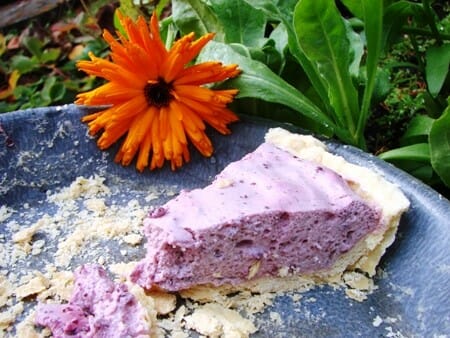
Blue Elderberry Edible Cream Pie. Home made from delicious Elderberry Syrup.
How to Make Basic Elderberry Syrup
The syrup is a beautiful rich purple color and incredibly delicious on homemade pancakes, vanilla ice cream, or made into wild elderberry cream pie! Because Elderberry has a low pH we freeze the syrup until needed.
Syrup recipe
- 1-quart ripe or frozen Blue Elderberries
- Juice of one lemon
- 3 cups water
- 1 - 2 tbsp Cornstarch or flour. If the syrup is thin, add another tbsp of Cornstarch or flour, and Honey. Or continue to reduce the liquid by simmering.
- 1/4 cup sugar or 1 cup honey
Crush Elderberries, add 1 cup of water and 1/4 cup of sugar. Or 1 cup of honey, to make the syrup thicker, and simmer for 15 minutes. Strain, and then add 2 cups of water to the seeds and pulp and strain again.
Add to the liquid the lemon juice and adjust the sugar if desired.
Bring to a boil and thicken slightly by stirring one tablespoon of cornstarch or flour in one tablespoon of cold water. Then stir this into the simmering syrup.
Makes 5 cups of syrup.
According to the author, Charlotte Bringle Clarke, "This syrup has few equals when used over pancakes or ice cream." I must agree with Charlotte.
Elderberry Cream Pie
The real reason I wrote this post is to share the delicate texture, the sumptuous pie filling that melts in the mouth, and the sweet-tart taste; just thinking about it makes my mouth water.
Harvest the ripe Blue Elderberries in the Fall
We harvest the ripe berries each Fall with great anticipation and delight. But after picking the ripe berries, we cook and reduce the berry liquid in preparation for making Elderberry Syrup. The syrup is the main ingredient before making the elderberry cream pie itself.
Elderberry Cream Pie Recipe Ingredients
NOTE: the recipe calls for a pre-baked pie crust. This is the only baking in this recipe. The filling is refrigerated firm in the pre-baked pie pan.
3-eggs, separated
2 Tbsp. grated orange or lemon peel
3/4 cup elderberry syrup
1-envelope unflavored gelatin
1/3 cup of sugar
pinch of salt
1/4 tsp cream of tartar
1/4 cup sugar
1-cup heavy cream
Bake in 9” pie shell
Blend until smooth the following ingredients:
Blend over heat until smooth: the egg yolks, Elderberry Syrup, unflavored gelatin, 1/3 cup sugar, and salt.
Do not boil. Add grated orange or lemon peel and pour into a bowl; refrigerate until slightly firm.
Do not refrigerate too long (like overnight), just long enough until slightly firm. The firming of the filling does not take long.
Beat the Egg and Cream
Beat the egg whites until stiff add cream of tartar and 1/4 cup sugar, beating continuously.
Beat heavy cream until fluffy and fold half into the egg-white mixture.
Fold the Egg-white mixture
Fold the egg-white mixture into the refrigerated sauce.
Pour into pre-baked pie shell and garnish with remaining whipped cream.
Serves 6
The Amazing Blue Elderberry, Thank you, Charlotte Clarke, for the delicious recipes!
Historical uses of the Blue Elderberry
I began learning about this shrub when I lived in the mountains of the Sierra Nevada. I discovered the local Miwok community used Blue Elderberry extensively for thousands of years. This useful shrub is of foremost importance to the Miwok culture.
Elderberry Blowgun
One of the cool things about Elderberry wood is its soft center pith. It can be scraped and removed to make a hollow stem. Straight shafts of a branch are split in half to remove the inside Pith. Finally, the two pieces are glued together and then wrapped with a cord for a serviceable Blow Gun.
Shorter straight sections of the wood are split part way and hollowed out for a Clapper Stick, a musical instrument enjoyed by the Miwok people.
Green Elderberry Bark
If you are using the Elderberry stalks green, you will want to carve off, strip, scrape, remove all the green bark, and let the wood dry some. A spindle from the Elderberry is excellent for the bow drill or hand drill friction fire-making process.
Elderberry Hand Drill Spindle
If you are a fan of the Man vs. Wild or Born Survivor series with Bear Grylls, Bear made a Hand Drill fire in the Sierra episode using a long slender spindle from the wild Blue Elderberry. An Elderberry spindle is an excellent choice for success for a bow drill or hand drill fire.
Leave Berries for Wildlife!
Elderberries are food for, Western blackbird, House Finch, Red-Shafted Flicker, Ash-Throated Flycatcher, Black Headed Grosbeak, Scrub and Steller Jays, Ruby-crowned Kinglet, Bullock’s, and Hooded Oriole, and Phainopepla. Don't forget the Bears! Leave berries for the bears too.
In Conclusion
Remember; positively identify any plant before use, edible, medicinal, or utilitarian application.
USDA Department of Agriculture - blue elder information
Miwuk Medicine use of Sambucus nigra
Recommended reading:
“Edible and Useful Plants of California” by Charlotte Bringle Clarke (Great wild food recipes include the elderberry pie and syrup I am sharing here.)
“Edible and medicinal Plants of the West” By Gregory L. Tifford
Check out this great recipe for Elderberry Barbecue Sauce by Mariah Gladstone


It is, delicious!
The Syrup sounds really good. I may need to try it!
Hi Amanda, thank you for catching that. I’ll make the change. You can add more or less sugar/honey as your taste desires. We tend to like the syrup a little tart. Thank you!
The syrup recipe is confusing. Under ingredients list it says 1/4 cup of honey or sugar but in the directions it says 1 cup. I’m going to assume it should be 1 cup since it’s a syrup.
Hi Mark J. thank you for your question. You asked What does “Bake in 9” pie shell” mean? There is no temperature or baking time given.” So only the pie crust is baked. The pie mixture, the filling, is poured into the pre-baked 9″ pie crust, and then refrigerated until firm. Then you’re done. I corrected the “bake-in pie shell” text. Thank you for bringing it to my attention. It’s a fantastic recipe for Elderberry I hope you try it!
What does :”Bake in 9” pie shell” mean? There is no temperature or baking time given.
Hi Janet, those all sound fantastic! Do you still make these wonderful drinks? Thank you for your comment!
We used to make “Elderberry champagne “…. Bubbly like ginger beer or root beer… when I was little. It was made with the blossoms and lemon juice & tartaric acid among other ingredients
Hi Beth, thank you for your question. Glad to hear you like the syrup. This recipe calls for 1 tbsp. of cornstarch or flour. We have found adding another tbsp. of cornstarch helps make the thin syrup much thicker. Careful not to add to much cornstarch to thicken. You can also reduce the syrup more to thicken. Just pour it back in your pan on your lowest setting and cook down the syrup slow for about 45 minutes. Make sure you stir often to keep it from burning. Let us know how it worked out.
I just made the elderberry syrup. It tastes great but very thin. Is this to be expected?
Can I thicken it up somehow?
Greeting Rachel. Always a treat to hear from folks in the UK. The flowers of the Blue Elderberry are edible and yes, can be eaten raw without cooking. The flowers like the fruit are medicinal. The berries of course need to be cooked, simmered, for at least 40 minutes before eating. Many plant books in the States have recipes using Elderberry flowers. The most common is frying the flowers in a Beer batter. I’ve tried it and not a fan. Though just about anything fried tastes good. Give it a try and let us know how it goes.
Great info. Thank you. I’m intrigued that you don’t mention using the flowers for recipes as with the Sambucus nigra. I imagine they’re also usable. What do you think? From a reader in the UK who would love to know! thank you.
Happy Thanksgiving everyone!
We recently returned from visiting new friends in Mt. Vernon Oregon. Dave Hamilton has a wonderful little winery that specializes in wild fruit wines. If you ever get to visit their winery, you will see Dave’s Lakota War Shirt on Display that his wife sewed. Made from brain tanned Antelope and decorated with Elk ivory, she also pounded the rock by hand and used the powdered rock to dye the shirt.
They make a terrific dry and what Dave calls a “frozen” sweet Elderberry wine that is very similar tasting to the blue elder syrup we make at home. Which is excellent. Dave has an amazing variety of wild wines to choose from. Wild plum, blueberry, Oregon grape, Chokecherry, and even a wild Rose wine! We sampled as many as we could, they were all fantastic, and we came back home with a varietal case of delicious dry and sweet wild wines. If you have an opportunity, we highly recommend a visit to
Dave Hamilton Winery, Mt Vernon OR.
You can reach Dave by phone – 541-932-4567