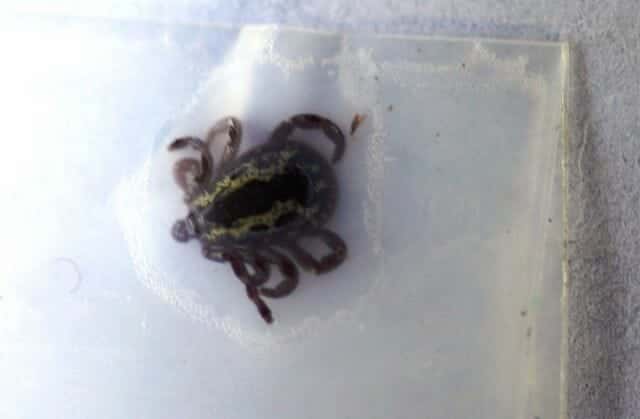
Spring on the Oregon coast is a wonderful time of year. But with the warmer weather, unfortunately, come insects that are potentially dangerous to animals and humans. The dog tick (Dermacentor variabilis) pictured here wrapped in Scotch tape. Are common ticks of the west coast from March through August. Read on for tips on ticks.
Tips on Ticks
Survival Gear and knowledge about and dealing with ticks.
Adult ticks wait on the tops of grasses, brush, and the tips of tree limbs ready to drop upon a suitable host that walk by. Like elk, deer, dogs, and humans.
- Use recommended tick repellents. Ben's Tick Repellent
- or Cutter Backwoods Insect Repellent. Both Ben's and Cutters have the chemical Picaridin which are proven in studies to repel ticks.
- Treat clothing and gear with products containing 0.5% permethrin.
- Wear light-colored long sleeve shirts, pants, and hats as a deterrent to tick bites.
- Scotch tape is a useful resource for holding ticks for identification.
- Identify that tick.
- Use fine-tipped tweezers to remove ticks - Northwestern Medicine
Ticks are abundant in elk and deer habitat
- Walking through a field where deer and elk inhabit. Will often, find you carrying a number of these nasty hitchhikers on your clothing.
- In addition, if you take your dog along with you on your hikes through the woods, they too will carry many ticks back home. It is important to check for ticks constantly while you are out hiking and when you return home.
Pets and Ticks
Domestic animals are susceptible to ticks
- Domestic herd animals such as cattle and horses are susceptible to tick infestation.
- If you live in North Carolina here is some shocking news on the Asian Longhorn Tick. Aka, Clone tick.
Ticks and house pets
We had a lot of pet's when growing up. Dogs, cats, and horses. We wandered everywhere in field and wood, so ticks have always been present in our lives. I removed ticks from our animals in the spring and fall, anything with warm blood is a potential victim of the tick!
Tips on removing tick's from your dog
Removing ticks from your dog or other domestic animals is simple and straightforward.
- Use fine-tipped tweezers to remove ticks from your dog.
- Grab the tick with tweezers as close to the tick's head as possible.
- Apply steady pressure outward by pulling the tick out.
Dispose of tick in a container with a small amount of alcohol. Or, wrap in tape like the photo above.
The use of Deet to repel ticks
Deet, what is it? According to -
“Science Daily (Aug. 6, 2009) — the active ingredient in many insect repellents, Deet (N,N-diethyl-m-toluamide), has been found to be toxic to the central nervous system. Researchers say that more investigations are urgently needed to confirm or dismiss any potential neurotoxicity to humans, especially when Deet-based repellents are used in combination with other neurotoxin insecticides.”
Use strong insect repellents to fight ticks
Use a strong mosquito repellent. Or even better use Permethrin (See cautions of use with domestic animals) as a tick repellent. Apply to cuffs and waist and belt line of your pants. Wear light-colored long sleeve shirts, pants, and hats can also be helpful as a deterrent to tick bites.
Lizards slow the spread of Lyme's
Ticks bite Lizards, and amazing things happen. Lizards Slow Lyme’s Disease
Rocky Mountain Spotted Fever
My brother-in-law had a case of Rocky Mountain spotted fever years ago and became very ill. I have had several friends, who after repeated attempts to diagnose bizarre symptoms of illness, tested positive for Lyme’s Disease.
Check for ticks
I once removed a tick from the middle of my Mothers back when I was eleven years old. Which is the most helpless place to have a tick if you are by yourself. It would fit nicely in “Dark Stories of Survival," or the scariest!
Lymedisease.org explains how to remove a tick
Lyme Disease Update
Here is a quote and update on Lyme Symptoms and treatment by Dr. Nevena Zubcevik, the attending physician at Harvard Medical School. Dr. Zubcevik research has debunked much of the current information on Lymes disease.
“The conception that the tick has to be attached for 48 hours to inject the bacteria is completely outdated,” she said. There are studies that show that an attachment of 15 minutes can give you anaplasmosis, 10 minutes for the Powassan virus, and for the different strains of Borrelia burgdorferi, we have no idea.” ~Dr. Nevena Zubcevik
Ticks rising in a warming world
"In a warming world, ticks thrive in more places than ever before, making Lyme disease the first epidemic of climate change."
The last word is to be tick aware
In conclusion, during tick season, maximize your tick awareness. Think tick and your mind and body will respond and help remind you to check for ticks. Wear the recommended clothing and tick repellent to prevent tick bites.


Some of the favorite places ticks
like to attach themselves on the human body are:
1) Between the upper part of your pants – belt – waist area. The pressure created by your clothing around the waist is a perfect place for a tick to bite the skin, we find ticks here often.
2) Back of the neck is another favorite place for ticks, check this area often.
3) All the warm dark area’s of the body, armpits, groin, behind the knee, and back are all favorite area’s for ticks.
Yes even the most private area’s of our body are not immune to the advances of the nasty Tick.
Thanks Greg for sharing your experience with Lymes and a good heads up for folks with illnesses that won’t go away.
I have a friend as well who completely became dibilitated before the doctors (After the third blood test) finally were able to confirm that she had Lymes. Really a heart breaking story.
She contracted Lymes when she was living in the hills north of San Francisco near Point Reyes National seashore. That area used to have the highest rate of Lymes in the west.
Tom Brown used to joke that so many folks from Marin County had taken his classes in the Pine Barrens, that they no doubt brought the Lymes ticks back to California.
Folks check out Greg Weis website, he runs a very cool outdoor skills school in the upper reaches of Wisconsin. Check out his website http://www.nativeways.com
Thanks again Greg.
Hi Mark and all,
I was treated for Lymes that I’d had for supposedly 15 years last spring. I knew I had it the first time but back then the treatment was inadequate (at least at this doctor) and after telling my doctor (a new one) the current symptoms and my past treatment he recomended two months of anti-biodics. After a few weeks I began to feel better and have not gotten a cold all winter until recently.
One reason I’m tellin my story is that I never knew how Lymes can attack your immune system and lower your white blood cell count. If you feel tired often or get sick “easily” (easily can be defined as your friends are “sick” of hearing that you’re sick again) You may want to consider the possibility that you have Lymes, or if you know you’ve had lymes that you want to make sure that it is treated fully.
Greg
Hi Mark
One preventive measure is to do daily tick checks on everyone (kinda like chimps grooming but you don’t have to actually eat the buggies you find on each other). Since Lyme takes > 24 hrs of tick contact w/ the skin to disgorge the borrelia bacterium, if you pluck any ticks off in that time frame the chances of contracting Lyme disease are low.
Meg